Market and DOOHProgrammatic
Programmatic DOOH: when an auction fills the slot
Advertising time on screens can be traded automatically. The standard comes from online advertising and had to be adapted for screens.
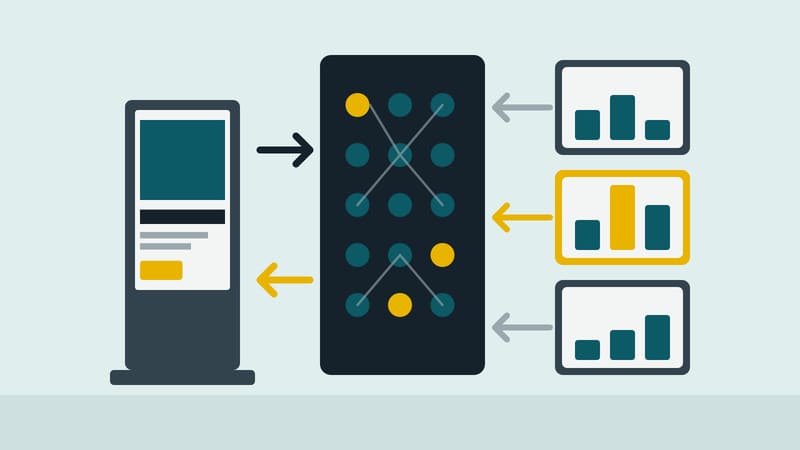
Traditionally, advertising time on screens is booked like a poster: location, period, price, contract. In programmatic trading, or programmatic DOOH, an automatic auction decides instead which creative gets a free slot in the loop. The language sellers and buyers use to talk to each other is called OpenRTB. It comes from IAB Tech Lab and was designed for advertising on websites and in apps.
How the auction works
The operator of a screen network offers a free slot to an exchange. The exchange sends a bid request to connected buyers: here is a slot, these are its properties, who is bidding? The buyers answer with a price and a creative. The highest bid wins, the creative is delivered and the play is reported back. On the sell side there is usually a platform offering the inventory, on the buy side one bidding on behalf of advertisers.
What the standard added for screens
Since version 2.6, OpenRTB has contained two objects that did not exist before.
The DOOH object describes the medium. It takes the place of the details about a website or app; a bid request may contain only one of the three. Among other things it gives the name of the placement and the type of venue according to a shared taxonomy; the default is that of the OpenOOH project.
The quantity object carries the multiplier. Online, one impression is one user. A screen shows a spot to everyone who happens to be nearby. The multiplier states how many impressions one play counts for and names the source of the measurement. The standard gives 14.2 as an example.
There is also a timestamp for the moment the spot is expected to be shown.
Four differences from a web page
The implementation notes accompanying the standard list what separates screens from online advertising.
Size. Everything is traded, from a shelf-edge label to the area of several football pitches. Formats, resolutions and aspect ratios vary accordingly.
The network. Most commercial screens sit on walled-off private networks. That protects them but prevents the third-party measurement and counting methods common online. Many media owners therefore supply their own playout reports. Location cannot be derived from the network address either; the publisher reports it.
The connection. Many screens rely on mobile networks and are not permanently reachable. Bids are therefore requested in advance and creatives are buffered. The notes give a lead time between bid and display of up to one to two hours as currently accepted in the industry. "Real time" in the literal sense is not what happens.
The devices. Unlike phones, there are no globally dominant brands. Each network has its own device types and identifiers.
What operators can take from this
Programmatic is an additional sales channel, not a replacement for a network's own sales. Before a network hands its inventory to an exchange, four points should be settled:
- Approval. Who checks a creative bought by a machine before it runs at the site? A lead time of hours leaves room for that, but only if the check is built in.
- Blocks. Can categories and competitors of the site be excluded before bidding takes place?
- Multiplier. Who determined it, and does the buyer accept the source?
- Proof. Do the network's own playout logs match the exchange's billing? The notes warn of discrepancies when the two sides truncate decimal places differently.
For small networks with a few sites and regular local customers, direct booking is usually the simpler route. Programmatic trading is worth setting up only once slots regularly stay empty that buyers from outside the region could fill.