Market and DOOHAd loop
Why the ad loop must not shrink: the filler content
If an ad slot goes unsold and drops out of the loop, every booked spot plays more often than it is paid for. How filler content prevents that and what it must not do.
Kapaso solution: What this article describes is made by the publisher of this magazine.
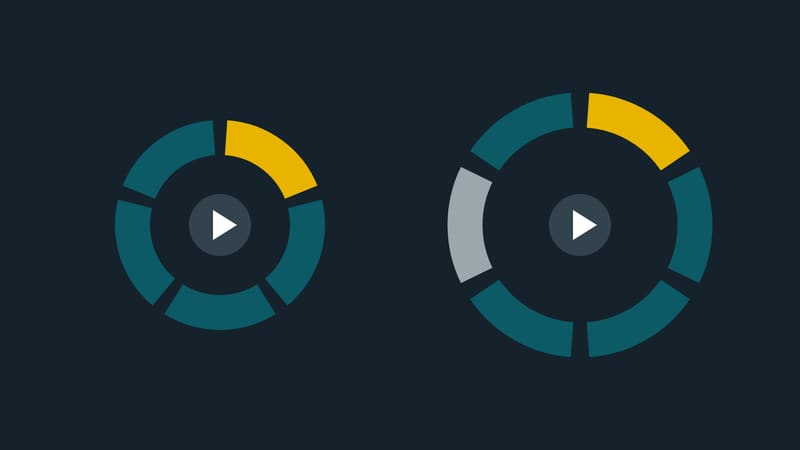
A screen in an operator's network has a broadcast loop: a sequence of content that repeats. Part of that loop is reserved for advertising, in slots of a few seconds. The operator sells these slots through a portal, and the advertiser pays for a certain number of plays of their spot. The procedure has a catch that only shows in operation: what happens to a slot that nobody has booked?
When an empty slot disappears
The simplest answer is to leave it out. The loop is then shorter, and everything that remains moves up. That is exactly the mistake. A shorter loop repeats more often, and every booked spot plays more often in the same hour than was sold. The advertiser gets more contacts than they paid for, and for the operator the proof becomes implausible: they cannot explain why a spot played so often.
That is not a fringe effect but the result of an unremarkable assumption: that an empty slot costs little.
The countermeasure: filler content
Filler content is a motif that the network operator maintains and that runs on every unsold slot. The loop thus stays as long as promised, even if nothing is sold. A hub delivers it to the CMS in the schedule; if it is missing, the slot disappears as before.
Clear rules apply to filler content:
- It belongs to the network. It is not an advertiser's motif and can never be booked.
- Two formats. A network needs one in landscape and one in portrait. A landscape filler on a portrait screen would be a dummy with black bars.
- It plays but is never reported. It has no booking, and a proof for it would be a record without a counterpart. It would also count against the screen's plausibility limit.
- Changeable per screen. A filler of its own on a screen takes precedence; if the field stays empty, the network's applies.
- No filler, no booking. If neither the screen nor the network has one, the screen cannot be booked. That way no screen is sold whose loop would later shrink.
What filler content must not do
The hub invents nothing. There is no automatically generated placeholder and no black image covering an empty slot. Filler content is a real motif that the operator maintains and is responsible for. Slots above the screen's ad share deliberately stay empty: they are not ad slots of this screen, and filling them would make the loop longer than was reported to the portal.
A rejected filler also drops out of the schedule. In that case the screen reports "Filler missing", and the operator sees that something needs doing.
What follows for operations
For network operators marketing screens through a portal, a short checklist follows:
- Does every network have filler content for landscape and portrait?
- Does the length of the filler match the length of a slot?
- Is the filler checked now and then, especially if it contains motifs tied to seasons or promotions?
- Does the CMS that fetches the schedule know what to do when filler is missing?
The last point is the least conspicuous. Systems that leave a slot out without replacement shorten the loop and trigger exactly the problem the filler is meant to prevent.
A principle behind it
The portal tells the CMS what, how often and in which window to play, but never where in the loop. That principle keeps third-party CMS open: they need disclose nothing. The filler does not contradict this: it does not decide where something sits but what an unbooked slot is filled with.
The hub described here is a solution from Kapaso GmbH, the publisher of this magazine.