Market and DOOHBilling
E-invoicing: transition period for larger screen networks ends with 2026
From 2027, businesses with prior-year turnover above €800,000 must issue invoices to other businesses as e-invoices. That includes advertising time sold.
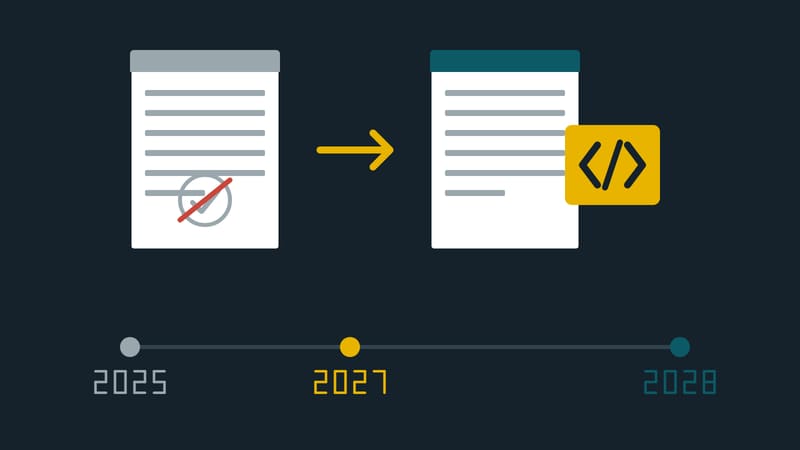
Anyone selling advertising time on screens writes invoices to businesses: the furniture shop, the driving school, the agency. In Germany, invoices between domestic businesses have been subject to e-invoicing rules since 2025, so far with generous transition periods. The first of these runs out on 31 December 2026, a few weeks from now.
The three dates
The German Federal Ministry of Finance summarises the rules in a questions-and-answers page (dated 23 March 2026, accessed 3 October 2026). On receiving invoices it states, in German, that since 1 January 2025 domestic businesses have needed to be able to receive an e-invoice.
For issuing invoices the ministry lists transition periods:
- Until 31 December 2026 all businesses may still issue another kind of invoice instead of an e-invoice, meaning paper or PDF.
- Until 31 December 2027 this applies only to businesses whose turnover in the previous year did not exceed €800,000.
- From 2028 that threshold disappears as well.
A network operator or sales house turning over more than €800,000 in 2026 therefore has to issue e-invoices from January 2027.
What counts as an e-invoice
As the ministry describes it, an e-invoice is an invoice in a structured electronic format that can be processed by machine and complies with the European standard series EN 16931. A plain PDF does not qualify. The page names XRechnung and ZUGFeRD from version 2.0.1 as the formats commonly used in Germany, excluding the MINIMUM and BASIC-WL profiles. ZUGFeRD combines a readable PDF with an embedded data record; XRechnung consists of the data record alone.
According to the ministry, the exceptions include small amounts of up to €250 gross, invoices from small businesses under the German small-business scheme, and invoices to recipients who are not businesses.
Where DOOH businesses get stuck
In smaller networks the invoice is often made by hand: the booking record becomes a PDF in a word processor. That route does not produce a structured format. Three points deserve a look before the year ends:
- Check your own turnover. The ministry refers to the prior-year turnover of the business issuing the invoice, meaning the whole business and not the advertising arm alone.
- Trace the path of the invoice. Which program creates it, and can it output XRechnung or ZUGFeRD?
- Think about corrections. If a screen fails and fewer plays are delivered than booked, a correction follows. Where e-invoicing is mandatory, the ministry's page says the correction must be issued as an e-invoice too.
Small amounts are common in local advertising. As the ministry describes it, an invoice of up to €250 gross falls within the exception. Whether a network wants to maintain a second invoicing route for those is another matter.
An example from the publisher's own house
Kapaso GmbH, the publisher of this magazine, runs DOOH Hub, an advertising portal for screen networks. According to the company, the portal invoices after playout and issues every invoice as a PDF and as an e-invoice in the XRechnung and ZUGFeRD formats. For bookkeeping, the finalised invoices for a month can be downloaded as a posting list together with the XRechnung files. If a network issues its own invoices, it receives a commission invoice from the portal in the same format.
Keeping records
According to the ministry's page, invoices must be kept for eight years. For an e-invoice, at least the structured part has to be kept intact in its original form; with ZUGFeRD that part takes precedence. On that reading, the printout alone is not enough.
This article reflects the source named above and is not tax advice.
DS Content kompakt
The magazine’s newsletter: three articles and one practical tip, by email about every two weeks.