Health and public servicesIndustry
Pharmacy: what a screen in the sales area may show
Opening hours, emergency service, services: safe. Prescription medicines, endorsements, vouchers: the German Medicinal Products Advertising Act sets limits.
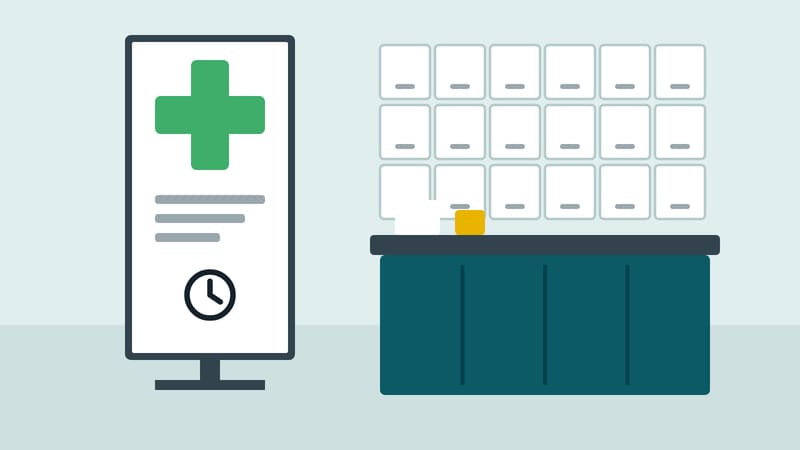
In hardly any sector is the clientele as varied and advertising law as strict as in a pharmacy. A screen in the sales area faces people who are, as a rule, not trade professionals. It is therefore worth looking at the German Medicinal Products Advertising Act (HWG) before the first playlist is made. This article summarises two sections and is not legal advice.
What is safe to run
Screens do not have to advertise medicines. Much of what customers ask every day is pure information:
- Opening hours, including public holidays and the days between the years
- Emergency service: who is on duty tonight and at the weekend (the exact source is provided by the state chambers; what the screen shows must match it)
- Services such as delivery, vaccination advice, blood pressure checks or a medication plan
- Notes on collecting pre-ordered goods
- Team introductions and data protection notes at the counter
- Notes on which documents to bring when collecting a prescription
Here a screen can do more than a notice because it changes as soon as the situation changes.
What the law does not permit
Prescription-only products. Under section 10(1) HWG, prescription-only medicines may be advertised only to doctors, dentists, veterinarians, pharmacists and persons who are lawfully allowed to trade in them. A screen in the sales area also reaches everyone else. Prescription-only products therefore do not belong on this surface.
Further limits outside the trade. Section 11(1) HWG lists what may not be used in advertising outside the professional circles. Most relevant for screen content:
- Endorsements by scientists, healthcare workers or well-known people who could encourage use of a medicine (no. 2)
- Statements suggesting that health could suffer if a product is not used or improve if it is (no. 7)
- Advertising aimed mainly at children under 14 (no. 12)
- Vouchers for medicines and the handing out of samples (nos. 14 and 15)
Some of these points apply in the same way to medical devices.
The grey area: over-the-counter products
Between "may" and "may not" lies what is sold without a prescription, such as food supplements, cosmetics and cough syrup. The law has rules for these that go beyond the two sections named. A screen praising a cough syrup as "guaranteed to help" brings trouble even if the product is freely available. Anyone who wants to show such images should have them checked first.
Practical consequences for the technology
- One responsible person. Whoever releases content should be one person in the pharmacy, not the whole team.
- Third-party content only after review. Advertising material from manufacturers or agencies does not keep running automatically just because it was supplied.
- Emergency-service data must be current. A wrong emergency service on the screen is worse than none.
- Prices for services belong in a price list if services are offered; where a shop window exists, there too (section 12 PAngV).
A simple rule of thumb
Anything that is information can go on the screen. Anything that advertises a medicine is a case for review. And anything that advertises a prescription-only product stays off.