Health and public servicesWarnings
Warnings on screens: what is possible and what is not
City information boards can be connected to the federal warning system. A screen in a practice, office or company is not part of it but can carry notices of its own.
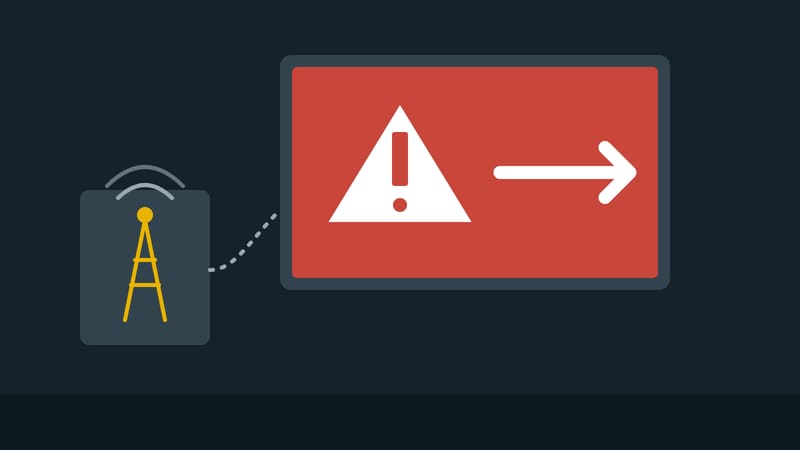
A screen hangs in the foyer of a practice, an office or a company, and one day the question arises: can it also warn? The answer has two parts. Official warnings to the population run through a system of their own, to which an ordinary screen is not connected. Notices of your own for the people in the building, on the other hand, are possible and sensible if the procedure has been settled beforehand.
The official warning: a route of its own
The Federal Office for Civil Protection and Disaster Assistance (BBK) lists sirens, radio, television, online services, digital city information boards, passenger information systems, warning apps and cell broadcast as warning means. Of the city information boards it says they must be connected to the Modular Warning System (MoWaS). Anyone who wants to know whether their municipality runs such boards should, according to the BBK, ask the city or municipal administration. Retrieved on 3 October 2026.
On the nationwide warning day, held on 10 September in 2026, city information boards were among the channels through which the test warning ran, alongside radio, television, sirens, warning apps such as NINA, Biwapp, KatWarn and Warnwetter, and cell broadcast. That is reported by the Lower Saxony interior ministry (retrieved on 3 October 2026).
For practice this means: a screen that happens to run digital signage software is not part of this system. Whoever wants to show official warnings there has to clarify with the responsible body whether and how a connection is possible. A home-made solution that pulls warnings from the internet and shows them does not replace the connection and can cause confusion if it differs from what the authority sends. This article is not legal advice.
Notices of your own: what makes sense
For people in the building, for example in a house alarm, evacuation, power cut, water damage or a closure, a screen can show notices of its own. It then supplements what applies anyway and does not replace it. The prescribed marking of escape routes and alarm routes in the building remains a matter for those responsible for safety; a screen can fail, signage cannot.
A notice on the screen needs five properties:
- Priority. It interrupts everything else and covers the whole area. A small notice at the edge is overlooked in the rush.
- Clear text. A heading with the action, for example "Leave the building", beneath it a short sentence with the route. Avoid technical terms and abbreviations.
- Readable without sound. In such a situation not everybody listens, and some cannot. Text and symbol carry the message.
- Contrast. Strong colour, large type, no fine lines. A notice that cannot be read from a distance is of little use.
- An end. Every notice has a defined state to which the screen returns, and someone who withdraws it.
The procedure, not the technology, decides
Most of the work lies outside the software. Before the first use it should be settled:
- Who may trigger it? A small group, with deputies. The more people may trigger, the greater the risk of a false trigger.
- Where is it triggered? From a place that is reachable in an emergency too, not just from one person's desk.
- How is it withdrawn? Who decides that the situation is over, and who restores normal operation?
- What is on the screen? The texts are written, checked and stored beforehand, not worded in an emergency.
- Which screens show it? All, only those in the affected part of the building, or only reception? The result belongs in a list.
Rehearse before it gets serious
An emergency notice that has never been tried does not work reliably. A rehearsal at an announced time shows whether all devices react, whether the texts are legible and how long the return takes. It should be announced so that nobody takes it for a real emergency. A rehearsal that belongs to a date on which drills happen anyway, such as an evacuation drill, has proved its worth.
What a screen cannot do
A screen reaches only those who look and are within sight. People with impaired vision, visitors in the next room and everyone who does not notice it do not get the message. It is a supplement to loudspeaker announcements, sirens, staff and signage. Whoever relies on it alone plans a gap.
This magazine is published by Kapaso GmbH; the article describes general practice and refers to no product.