Health and public servicesWaiting area
Waiting time as a range, not a promise to the minute
The KAS Control kiosk states the wait in one of three forms, or not at all. The server decides which, depending on how solid the basis is.
Kapaso solution: KAS Control is made by the publisher of this magazine.
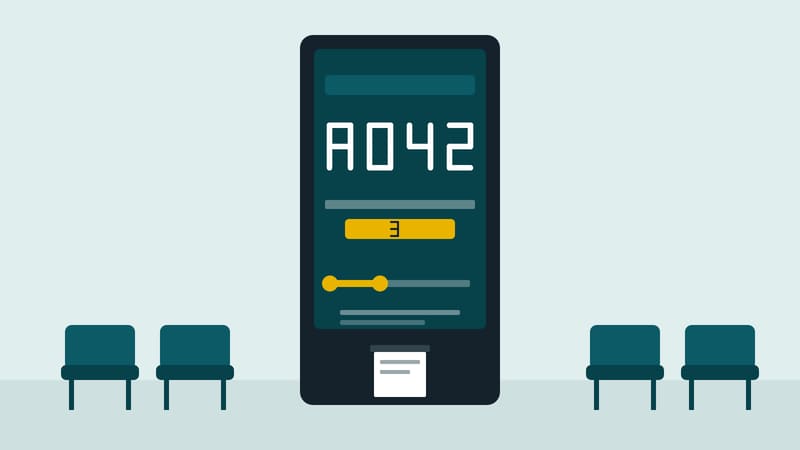
Anyone who takes a queue number wants to know two things: when their turn will come, and whether there is time to step outside. A display that answers with a single number of minutes gets checked against the clock on the wall. If the number is wrong, nobody trusts the display on the next visit.
The difficulty is in the arithmetic. A waiting time depends on how many counters are staffed, how long each type of request takes and whether someone with an appointment is called first. If one of these is missing, the result is a guess.
The number of people first, then the time
In Kapaso's KAS Control queuing system, the large figure on the kiosk's result screen is the number of people ahead. A time appears below it only when the server can stand behind it, and never as a single value. The server assigns every ticket to one of three levels:
- No time: no counter that can call this type of request is staffed, or there are neither measured nor configured handling times. If no counter is staffed at all, the kiosk says exactly that.
- Open range: there is a basis, but an appointment or a prioritised ticket may come in between. The kiosk shows "from approx. 20 min" and a note that appointments may come in between.
- Closed range: there is a basis and nobody can jump the queue. The kiosk shows, for example, "approx. 10–20 min" with a sentence saying what the estimate rests on.
The range is rounded to steps of five minutes. A calculated value of 16 minutes becomes "approx. 10–20 min". Below ten minutes the kiosk shows "under 10 min", above an hour and a half "over 1.5 hrs". A statement such as "4 minutes to go" can no longer be produced.
For operators this has a consequence: the more precise form is only available with maintained data. Those who enter a duration per type of request and assign counters to request types get the closed range.
Calling by number and room
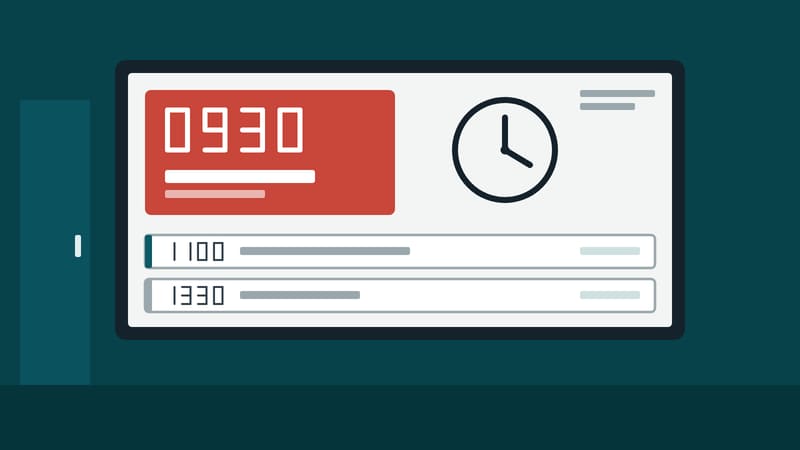
Calls appear on the wall display, with a chime and a spoken announcement. The default is the number and the room; a name in the announcement can be switched on but is not needed. The wall display is a browser page with six layouts, one of them with a media area, QR code and ticker. Devices with a web browser are enough as hardware: a TV or monitor, a touch screen as the kiosk, a PC or tablet at the counter. A receipt printer is possible but not required.
Where the limits are
The kiosk and the view on the visitor's own phone show the same range. Where the server cannot stand behind a time, for example when no counter is staffed, there is no number, only the reason.
KAS Control runs hosted by Kapaso, according to the vendor in a data centre in Germany, or on the customer's own server. There it runs as one container with one database file and, if desired, without an internet connection. That covers the core function. SMS and WhatsApp go through an external messaging service, and the AI voice for announcements and a translation helper use OpenAI in the United States. Both are active only when switched on; without AI the device's or the server's own voice makes the announcement.
There is no ready-made GDT or HL7 interface to practice software. Integration is done through the open programming interface.
More information: kascms.de