TechnologyEnergy
Energy label: why some signage displays carry none
Since March 2021 the EU label has also applied to digital signage displays. But the regulation exempts precisely the bright, large and outdoor-built devices.
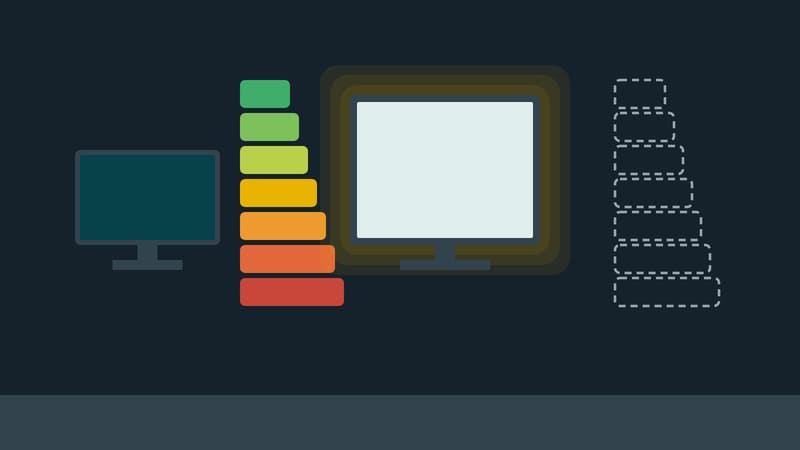
Televisions and monitors have carried an EU energy label for years. Since 1 March 2021 the underlying regulation has also applied to digital signage displays. Yet anyone buying a professional display will not find the label on every device. The reason is a list of exemptions that covers exactly those devices that need the most power.
What the label shows
Delegated Regulation (EU) 2019/2013 governs the labelling of electronic displays, explicitly including televisions, monitors and digital signage displays. The label assigns a device to an efficiency class from A to G. According to the European Commission it also states energy consumption, screen diagonal and resolution. A QR code leads to the product database EPREL, which lists, among other things, standby consumption.
Which signage displays are exempt
Article 1 of the regulation exempts digital signage displays that meet any one of the following characteristics:
- The device is a module intended as part of a larger screen area, for a video wall for example.
- It is supplied in an enclosure for permanent outdoor use.
- The screen area is less than 30 or greater than 130 square decimetres.
- Peak white luminance is 1,000 cd/m² or more.
- Pixel density is below 230 or above 3,025 pixels per square centimetre.
- It has a specialist form factor for installation in professional housings or consoles.
For orientation: at 16:9, 30 square decimetres corresponds to a diagonal of about 33 inches, 130 square decimetres to about 69 inches. A 32-inch device is thus just below the threshold. A 43-inch indoor display with 350 nits therefore carries a label. The 75-inch totem, the bright shop-window device and the outdoor display do not.
What applies to all of them anyway
The second regulation, (EU) 2019/2021, sets minimum requirements for the devices themselves. The on-mode energy efficiency requirements do not apply to digital signage displays. The reasoning is given in the recitals: such displays are often used in bright places and run continuously; on-mode requirements should be evaluated once more data is available.
The remaining parts do apply. They include limits for modes other than on-mode: no more than 0.30 watts in off mode, 0.50 watts in standby and 2.00 watts in networked standby. They also include repairability rules: certain spare parts must be available for at least seven years after the last unit of a model has been placed on the market. The latest firmware must be available for at least eight years, and the latest security update for the same period, free of charge.
What this means for purchasing
For screen networks the networked standby figure is the most important number. A display that is switched off at night but can still be woken over the network spends many hours a year in that state.
Three points belong in every enquiry:
- Label or data sheet: if the device carries a label, the class is enough for comparison. If it carries none, on-mode power has to come from the data sheet.
- Standby consumption: the figure is in EPREL or on the data sheet.
- Updates and spare parts: until when will the manufacturer supply firmware and power supplies for this model?
For 2020 the Commission gives an average power demand of about one watt per square decimetre of screen area. For signage displays the regulation itself notes that their energy needs are generally higher than those of other displays. All the more reason to look at the hours in which it does not need to be lit at all.